I din röst bor anden till ett språk
Accelerator presents the exhibition I din röst bor anden till ett språk [In your voice dwells the spirit of a language] by Olof Marsja, with several new works alongside sculptures from recent years. The exhibition features a central sound composition exploring a new focus in his practice: the loss of a language and its origins.
 Olof Marsja's exhibition 'I din röst bor anden till ett språk' [In your voice dwells the spirit of a language] is presented 14 March – 14 June 2026.
About the exhibition
Drawing on his extensive knowledge of materials, Marsja combines them to create works that oscillate between ancient times and the present. The imprint of the hand is clearly visible, reflecting a legacy of form and knowledge from forefathers and foremothers through family patterns and duodji (Sámi crafts). In the exhibition, Marsja traces the shared genealogy of the material, the hand and the language. In his speculative family tree, the land, the mountains and the river occupy equally important positions. The links in the tree, between the living and the dead and between the lost language and the language of the ancestors, are connected by the names, the joik and the wind.
I din röst bor anden till ett språk is located in Accelerator’s underground exhibition space. Through his practice, Marsja creates figures that step out of their parallel world. At Accelerator, visitors are instead invited to descend into their cave for the first time. The artist speculates about the earth’s surface as a boundary to a place of disintegrated timelines, where past lives and the yet unborn coexist in the face of an impending transformation. He attributes roles and personalities to his works in a cosmos of his own, where relationality and transition replace the dichotomies that characterise the present. In this world, there are protective amulets, amnesiac characters, ecstatic dancers and spirits. Marsja sees them as trailblazers and guides with an integrity that makes them enigmatic. There is a sadness over lost history, but also a vitality, perhaps a wind, perhaps a spirit that brings playfulness, excitement and agency.

Works in the exhibition
Hand I, 2017, The Artist’s Foot, 2026 and Gore Feet, 2022
The individual sculptural body parts in the exhibition reflect Marsja’s perception of the body and the self as composed of different fragments. The foot is a recurring motif that emphasises contact with the ground, and the hand leads the way in his dialogue with the material’s agency, history, memory and relationships.
Unfinished duodji work, aluminium, hand-blown glass, reindeer antler, soil, chocolate, a slipper from plaster work in the studio—materials from different periods in Marsja’s artistic practice have been brought together in these three works.
Needle housings from the work What if the Bear Is the Sun and the Sun Is the Bear, 2021
The bell-like glass objects with hanging metal rings recur throughout the exhibition. The form refers to a so-called needle housing—a bone case for sewing needles that’s attached to the belt. The needle housings hang at the entrance to the exhibition as a gesture offering the necessary equipment to visitors. For Marsja, the needle housing symbolises protection for the creative force. Brass rings are a traditional part of belt equipment, which are believed to ward off evil.


Close reading of the fantasies of the colonial power, 2026
Like many of Marsja’s characters, the two cyclops in the room are nomads. Dressed in outdoor gear, they are equipped for travel. The figure makes notes on a graphic print representing Lapland from Suecia antiqua et hodierna, 1660–1715. With royal blessing, the Swedish military engineer and architect Erik Dahlbergh created the book with 353 images that would document and launch Sweden internationally during the Great Power era. Buildings, landmarks, cities and landscapes were depicted with drastic additions. The image in the cyclop’s hand depicts Sámi people and a Sámi drum. During this period, Sweden’s colonisation of Sápmi intensified and many drums were stolen by the state.
Mii dáhpáhuvva dáppe, 2026
The title of the work is Northern Sámi for ”what’s happening here”. Marsja has given the figure a pose as if it is trying to orient itself or has stopped in the middle of a dance. In the Odyssey and the Theogony, two of the great early Greek poems (written around 700 BC), four cyclops are mentioned by name. Marsja is fascinated by how these ambiguous transitional figures are often reduced to simple-minded creatures in contemporary representations. In his version, the eye spreads across the entire face, providing both protective anonymity and agency. The large eye sees everything and does not need to speak.
Mu jienas orru giela vuoigŋa
[In my voice dwells the spirit of a language], 2025-2026
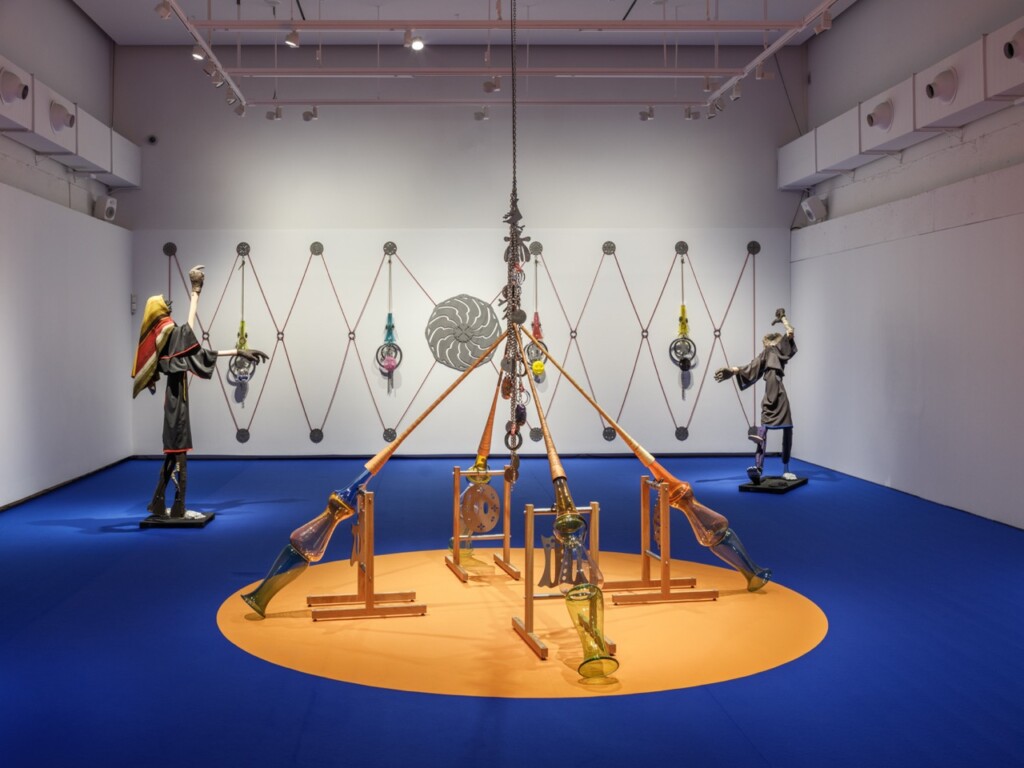
In the middle of the blue ground is an orange sun with four horns made of glass and birch bark pointing towards the cardinal points. The birch bark horn was used in mountain farming as a signalling instrument that carried across the landscape—to call animals, warn of predators and send messages. In the spatial sound composition, a muffled wind can be heard, which at times turns into a shrill warning sound. Above the wind, the artist and his mother can be heard talking to each other in Northern Sámi. Her language is fluent, his broken. The discrepancy between them is the starting point for the dialogue, where the relationship between language, land, heritage and identity emerges. The mother mentions family names associated with the lands where she grew up. She urges: put your ear to the ground, hear the clopping of hooves, hear the voices travelling with the wind, put the word in your mouth. He responds with sadness over a fragmented heritage, but also with a belief that it can be reclaimed. The spirit in the title is used as a metaphor for a latent force that can awaken language in one’s own voice. Marsja imagines the spirit travelling with the wind across the fields, through bodies, and carrying language forward through exhalation. The horns become a symbol for summoning language, as well as a warning about the responsibility of keeping it alive.
The Wheel of Time, 2026
The Wheel of Time is based on the structure of a family tree but with a circular genealogy; relationships between generations appear as simultaneous rather than chronological. The central disc is based on life-giving and unifying references: the sun, the wind and a traditional Sámi belt buckle. The round ornaments are Marsja’s stylised interpretations of relatives’ patterns in duodji objects. Beneath the needle housings hangs another connecting symbol in aluminium, based on brooches known as maljas. They hang together with glass faces of the Roman god Janus, associated with transitions, rebirth and duality. His two heads hold the past and the future together in the same gaze.
Dancer II-III, 2025
Two dancers let loose in ecstasy, unconcerned by the gaze of others. They have freed themselves from external expectations, tokenism and inherited shame, and instead take their place with proud, exuberant movements. Marsja has dressed them in suit fabrics often associated with high status. The Italian wool is cut in one piece, reminiscent of Bronze Age clothing traditions, and edged with fabric inspired by the decorative bands of the kolt. One dancer wears a rana as a headscarf. Ranas have been woven since the 7th century by the North Norwegian Sea Sámi and have been used throughout Sápmi as tent cloths or blankets. Marsja is fascinated by how this ancient heritage lives on in the woven tapestries from the 1960s and 1970s.


To the Wind, 2025, To the Voice, 2025, To the Geist, 2025
In Marsja’s underground world, the voice, spirit and life force are protected by three amulets. Fur frames a glass eye that represents a possible portal to other times and spaces. The design is inspired by two different objects: the oval Sámi drum and the risku, a piece of jewellery often made of silver, a material associated with protection in Sámi tradition.
With Open Arms I–III, 2023, The Wanderer, 2023, The Baggage, 2023
Five figures in a procession have stopped in mid-step. For Marsja, the flower represents both joy and sorrow: it holds the memory of seeing nature anew through his children’s eyes and the grief of a heritage lost as biodiversity declines. The last figure is dragging an IKEA blue-and-yellow FRAKTA bag. A well-known Swedish symbol closely associated with moving house, laundry rooms and recycling, is filled with duodji crafts and fragments of Sámi life.
Tiden, 2021
Gorpcore—a fashion style where functional outdoor clothing is worn for everyday use—gained popularity in the 2010s. GORP is an abbreviation of Good Old Raisins and Peanuts, a classic hiking snack. A piece of shell jacket from an outdoor brand hangs around a piece of oak. Plain scarves of this size tied in a similar way have been part of the Scout movement since its inception in the early 1900s. Before it became an outdoor movement, the aim was to provide young people with meaningful leisure activities, but also to prepare them for combat. This paradox also characterises the Western world’s idealisation of nature. The taxidermied green-
finch is on the Swedish Red List.


Untitled 1-31 (glass masks), 2025
31 masks line the walls of the room. Marsja keeps returning to the mask as a motif to explore the idea of an authentic self, starting from the idea that people assume different roles in life and that identity is situational and fluid. The work draws on several art historical references: masks of antiquity, grotesques, and so-called gargoyles—water spouts in the form of frightening figures and mythical creatures in stone that appear on Gothic buildings.
PPEZ, 2020
PPEZ has followed Marsja for a long time. It is a key figure in his character building, which he describes as a self-portrait. PPEZ is based on a nahppie, a Sámi utensil used for milking. During his studies at the Sámi Education Centre, Marsja dropped his nahppie on the floor. Even though it lost its function, he found it difficult to part with it and many years later he gave it legs. A rubbish bin, found in the artist’s current hometown of Gothenburg, became a place for it to rest. For Marsja, humour acts as a subversive tool that can process a fragmentary heritage.
Geist II, 2023
In Marsja’s universe, Geist II is a spirit incarnate, a nomad who can travel between the past and the present. Here, it enters to remind us that the dead live with us. Like several other figures, it is dressed in reindeer fur, a metaphor for taking on the family history. Marsja describes the reindeer body as something that symbolises both pride and burdensome expectations.
About Olof Marsja
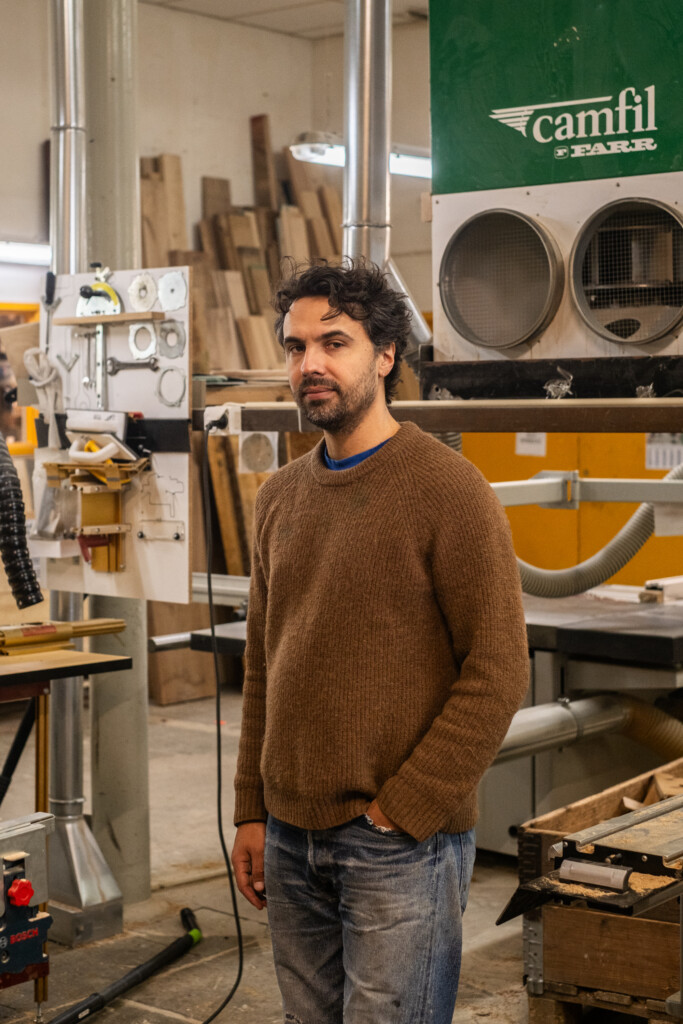
Olof Marsja (b. 1986, Sweden) explores collective and personal history through a mix of traditional craftsmanship and industrial materials in his sculptures and installations. In his merging of Sámi and Swedish elements, stories of identity, place, cultural heritage and history emerge, characterised by both sincerity and humour.
Marsja studied at Konstfack University of Arts, Crafts and Design in Stockholm, the Academy of Fine Arts in Helsinki, and the Sámi Education Institute in Jokkmokk. He has held solo exhibitions at 1646, The Hague, the Netherlands (2025); Örebro Konsthall (2025); Dalsland Museum of Art (2024); and the Sámi Center for Contemporary Art in Karasjok, Norway (2021–22). His work has been shown at, among others, Buffalo AKG Art Museum, New York; Kiasma, Helsinki; Moderna Museet, Stockholm; Lyon Contemporary Art Biennale; Luleå Biennial; Havremagasinet, Boden; Göteborgs Konsthall; Bonniers Konsthall, Stockholm; and Röhsska museet, Gothenburg. In 2019, he received the Maria Bonnier Dahlin Scholarship, and in 2023, he was awarded the Sten A. Olsson Cultural Scholarship.