
The exhibition The Owl of Minerva takes as its starting point questions about how knowledge arises and is valued. The title alludes to German philosopher Hegel’s idea that understanding an era becomes possible only in retrospect—“Minerva’s owl takes flight only at dusk”—and is an invitation to reflect on what counts as knowledge and when.
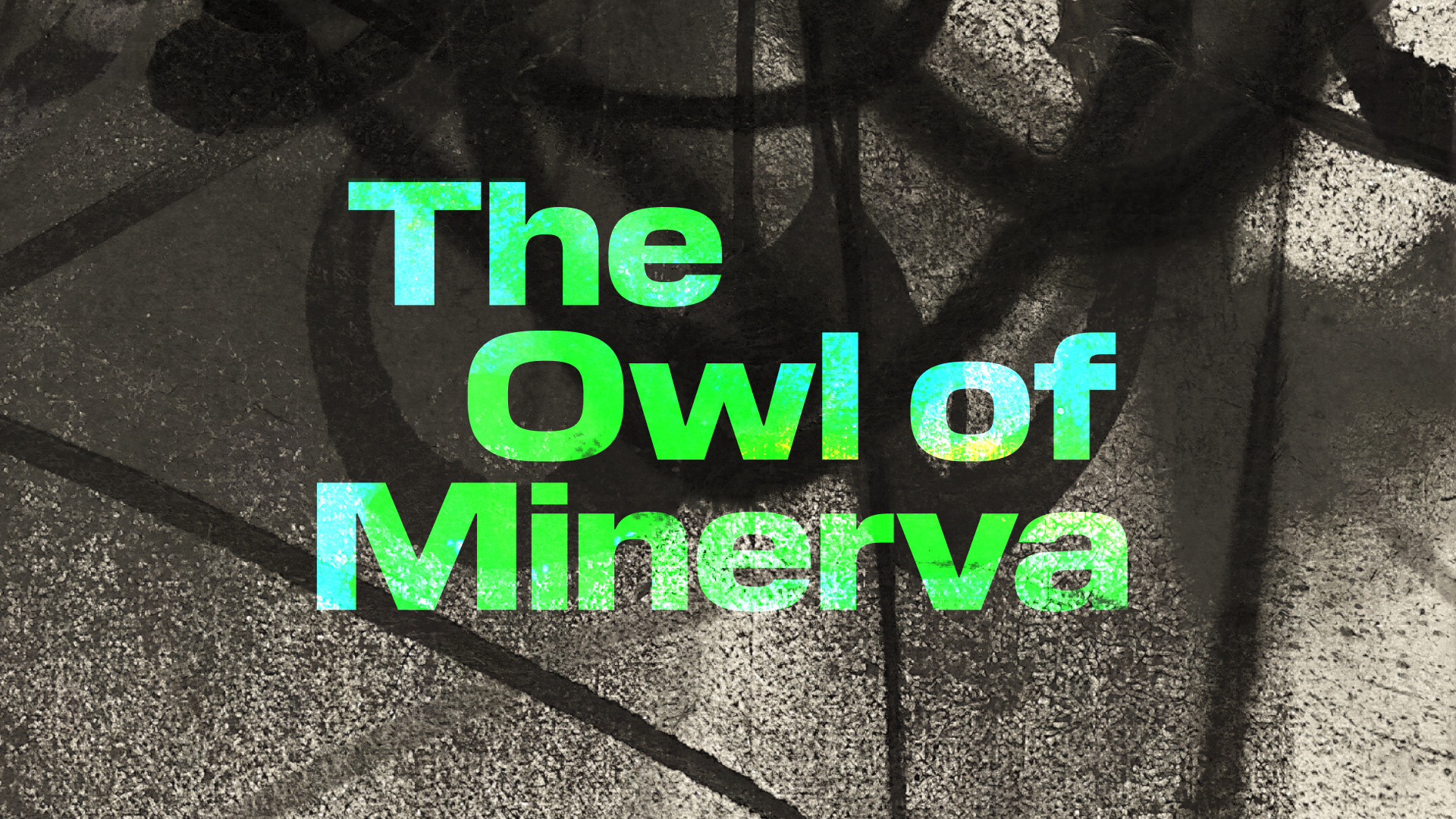 'The Owl of Minerva' with detail from a work by NUG. Courtesy of Steinsland Berliner Gallery.
About the exhibition
The exhibition presents works by artists Absalon, Stina Fors, Hassan Khan, NUG and Öberg/Arvefjord. Through installation, performance, painting, sound, and video works, the artists explore ways knowledge can be conveyed. Visitors are met with various expressions of bodies in motion, voices and rhythms. Most works are newly commissioned for the exhibition.
From its position within Stockholm University, Accelerator aims to draw attention to knowledge systems long excluded from, or subordinated to, academic knowledge. Knowledge shaped by the body, everyday life, heritage, and living conditions—lived and experience-based knowledge—is often marginalised, despite being fundamental to how people navigate the world.
The Owl of Minerva also highlights tacit knowledge—the kind of knowledge that is difficult to put into words but evident in action and practical skill. Above all, it emphasises intuition and rhythm as alternative ways of understanding and experiencing the world. Intuition manifests as a form of immediate knowing, beyond the strictly rational, while rhythm points to recurring patterns, movements, and temporalities—both in the body and in the surroundings. Together, these experiences broaden the understanding of knowledge as not solely conceptual but also involving emotional engagement and lived experience.
Participating artists
Absalon
Meir Eshel (Absalon) was born in Israel in 1964. Upon his arrival in Paris in 1987 he started calling himself Absalon and enrolled in Christian Boltanski’s workshop at the École Nationale Supérieure des Beaux-Arts. In 1990 he moved to a studio in Boulogne, built by Le Corbusier for the artist Jacques Lipchitz in 1924. Between 1991 and 1993 Absalon created his Cellules (cells) as small architectural forms which evoke monastic cells and relate to the dimensions of the artist’s own body and mental space. The form of Absalon’s Cellules is reminiscent of the modernist architectural styles of Le Corbusier, Bauhaus, De Stijl and the Russian constructivism. Apart from architectural structures and models, Absalon’s work encompasses films and drawings that from a personal perspective, explore questions of dwelling, security, and self-imposed isolation. At the age of 29, Absalon died of AIDS in Paris, in October 1993. During his short career, Absalon exhibited at institutions such as the Centre Georges Pompidou in Paris (1991) and took part in dOCUMENTA IX (1992) and at the Musée d’art moderne de la Ville de Paris (1993). KunstWerke in Berlin (2010), IVAM in Valencia and CAPC in Bordeaux (both 2021) dedicated exhibitions to his work.
Stina Fors
Stina Fors (b. 1989, Sweden) is a performance artist, choreographer, and experimental vocalist whose practice centres on the voice — its power, its failures, and everything that slips between the two. Working through solo and durational performance, she uses voice, rhythm, and embodiment to explore what happens when speech exceeds intention: as pressure, excess, noise, or unexpected revelation.
Her performances are humorous, raw, and risky — built on improvisation, punk energy, and agenuine appetite for the unpredictable. Key works include A Mouthful of Tongues (ventriloquism, vocal distortion), Stina Force (live drumming and vocal improvisation), and Answer Me, Pythia (a durational encounter with oracles, uncertainty, and belief). She has presented work internationally, including at the Venice Biennale and the Gwangju Biennale, and is the recipient of the H13 Lower Austria Prize for Performance. She studied at the School for New Dance Development (SNDO) in Amsterdam. Stina Fors is based in Vienna.
Hassan Khan
Hassan Khan (b. 1975, London, UK) is an artist, musician and writer. His work engages with familiar, shared conditions and undisclosed personal references, creating a form that gives rise to imagined communities. This form raises fundamental questions, channels conditions simmering under the surface, seduces and alienates, challenges expectations, and helps to re-articulate our experiences with shifting power structures. Working across video, photography, performance and installation, Khan views each medium not as a field to be mastered but rather a source of possibility, potential and learning.
Khan was awarded the Silver Lion at the Venice Biennale in 2017. Recent solo exhibitions include Little Castles, Portikus, Frankfurt (2025); GESTUS, Cukrarna, Ljubljana (2025); Blind Ambition, Centre Pompidou, Paris (2022); and The Keys to the Kingdom, Museo Reina Sofia, Madrid (2019). Khan’s An Anthology of Published and Unpublished Writings is published by Koenig Books and his album SUPERSTRUCTURE EP is released by The Vinyl Factory.
NUG
The artist known by the pseudonym NUG (b. 1973, Sweden) has been a prominent figure on Stockholm’s graffiti scene since the late 1980s and is considered one of Sweden’s leading graffiti artists. Despite maintaining a consistently low profile, he has attained an almost legendary status within graffiti culture, not least through his involvement with the crew VIM (Vandals in Motion). He became known to a wider audience through the controversial video work Territorial Pissing (2008), which sparked a national debate about the boundary between vandalism and art in public space.
Elize Arvefjord (Öberg/Arvefjord)
Elize Arvefjord is a composer and sound artist based in Stockholm. Her artistic practice explores the inherent materiality of sound and how it can be used to investigate the boundaries between worlds, objects, and bodies. She has composed music for productions at institutions including the Royal Dramatic Theatre (Dramaten), Norrdans, Stockholm City Theatre, Riksteatern, and Swedish Radio. In 2013, she received her Bachelor’s degree in Sound Design for Performing Arts from SKH and is currently studying in the Artistic Interdisciplinary Master Programme at the Royal College of Music in Stockholm. She is also a member of the performing arts collective Nyxxx, where she collaborates with the other members to create aesthetic events for participatory audiences.
Anna Öberg (Öberg/Arvefjord)
Anna Öberg (SE) is a dancer and choreographer working at the intersection of choreography, sound and spatial practices. In her artistic work, she draws on her background in Swedish folk dance and an interest in how the genre’s physical and social processes can be communicated through the position of art, beyond the simplified stereotypes and external attributes often associated with the genre. The improvisational interplay between music and movement has always been central to Öberg’s work, and she has frequently returned to the theme of rhythm as a driving force, passing the baton as a concept, and the interactive, multisensory encounter between the audience and the work as part of the choreographic material.
In 2015 Öberg was awarded an MFA degree in Choreography at Stockholm University of Arts (SKH), as the first traditional dancer in its history. She also holds a Post Master from The Royal Institute of Art in Stockholm, OPI Lab. Her stage works has been presented at e.g. Dansens Hus, MDT, Norrlandsoperan, Skissernas Museum, Moderna museet, Dansstationen, Riksteatern, Dansehallerne in Denmark, Rosendal Teater Trondheim, Riksscenen Oslo and Brut Imagetanz Vienna.
Credits
Curators: Richard Julin and Therese Kellner
Thank you to Jeanette Steinsland, Galerie Chantal Crousel (Paris), Magasin III Museum for Contemporary Art, and The Robert Weil Family Foundation.
Credits WonderWaves
Concept and idea Anna Öberg/Elize Arvefjord
Choreographer Anna Öberg
Sound artist and composer Elize Arvefjord
Co-creating dancers Viktor Fröjd, Jon Bugge Mariussen
Wood construction Max Landegren
Music Olof Misgeld
Associate sound designer Johannes Burström
Spatial advice Sofia Romberg
Technical support Christian Farcher
Production Anna Öberg/Nordberg Movement
Co-production Accelerator, Anna Öberg Dans
Supported by Swedish Arts Council, Stockholms Stad
Credits Nutcracker
With Stina Fors, Inga and Sylvia
Camera Rachel Chen
Additional camera Stina Fors
Sound Alex Shamku
Production coordination Kiel Torres
Technical support Ben Wilson
Editing Stina Fors
Commissioned and produced by Accelerator
Co-produced with Western Front
Filmed at Western Front, Vancouver, 2026